
Hamilton is the largest town in Mercer County and one of the most heavily traveled. Interstate 195 and Interstate 295 meet inside the township, the New Jersey Turnpike runs along its eastern edge, and Route 130, Route 33 and Nottingham Way carry local traffic through Hamilton Square, Mercerville and Yardville. That combination of highways, neighborhoods and commercial corridors means Hamilton police handle a wide range of drug cases, from a small amount found during a traffic stop to large-quantity distribution investigations. Drug charges in Hamilton range from disorderly persons offenses heard in the township’s municipal court to first-degree crimes prosecuted in Superior Court in Trenton. This page explains how drug charges are graded, why location can make a case far more serious, and the defenses and diversion options that can change the outcome. To talk about your case, call Keith Oliver Criminal Law at (609) 789-0779.
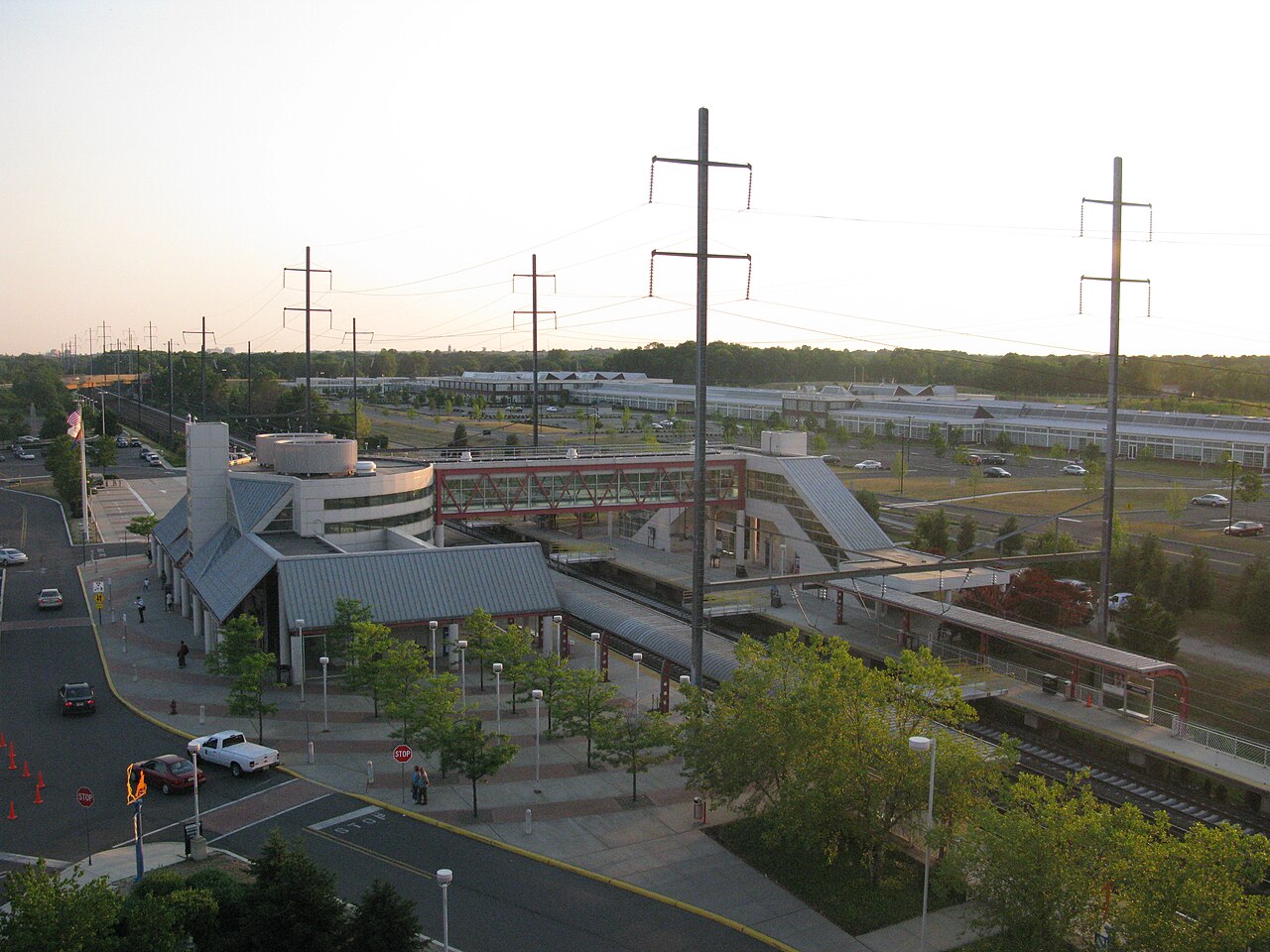
Hamilton train station on NJ Transit’s Northeast Corridor. Photo: Greg Goldstein, Wikimedia Commons, Public domain

Possession vs. Possession With Intent to Distribute
The most important line in a drug case is the one between possession for personal use and possession with intent to distribute. Simple possession of most controlled substances is a third-degree crime under N.J.S.A. 2C:35-10, and many first-time defendants can resolve it through diversion. Possession with intent to distribute, under N.J.S.A. 2C:35-5, is graded by the drug and the amount and can carry much longer sentences. Police and prosecutors often infer intent to distribute from circumstantial evidence: the quantity, how the drugs were packaged, the presence of scales, baggies, cash or a second phone, and text messages. Each of those has innocent explanations in many cases. Challenging the evidence of intent can turn a distribution case into a possession case, with far better options. See our drug distribution and drug possession pages for the statutes.
How Distribution Is Graded
For heroin and cocaine, the grade depends on the total weight. Less than half an ounce is a third-degree crime, with three to five years in prison. Half an ounce to less than five ounces is a second-degree crime, with five to 10 years. Five ounces or more is a first-degree crime, with 10 to 20 years. Other drugs, including fentanyl, methamphetamine, MDMA and marijuana, have their own thresholds. Because the weight includes the substance as packaged in some situations and the pure drug in others, how the lab measured it can affect the grade.
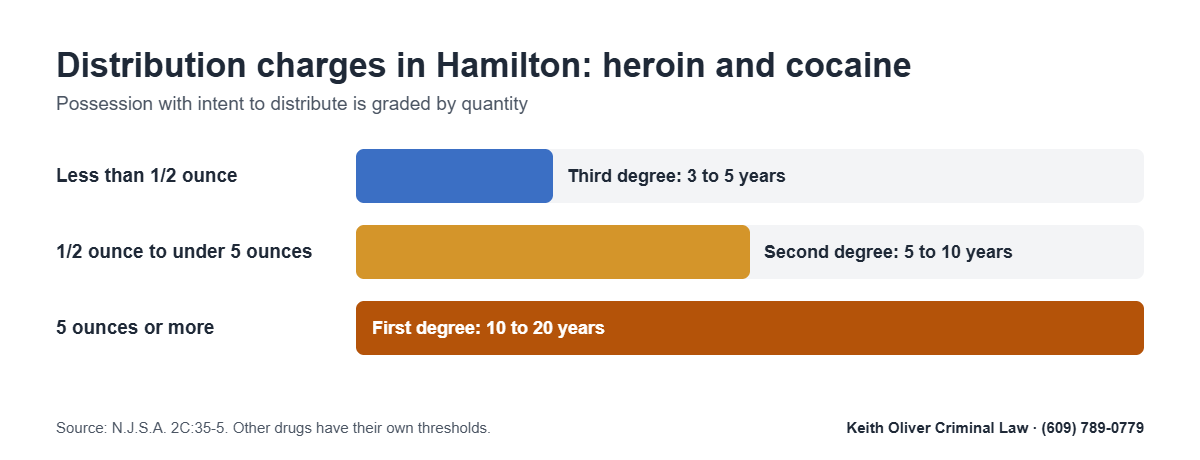
Heroin and cocaine distribution charges are graded by quantity.
Location Matters: School and Public Property Zones
New Jersey adds separate charges when distribution happens near certain places. Under N.J.S.A. 2C:35-7, distributing or possessing with intent to distribute within 1,000 feet of school property or a school bus is a third-degree crime. Under N.J.S.A. 2C:35-7.1, doing so within 500 feet of public housing, a public park, a public building or library, or a museum is a second-degree crime. In a town with as many schools and parks as Hamilton, those zones cover a large share of the map, and it does not matter whether school was in session or whether the person knew the zone was there. Zone charges are often central to plea negotiations. Prosecutors and courts have some ability to waive or adjust the related penalties, and accurate maps and measurements matter. See our pages on school zone and public park zone distribution.
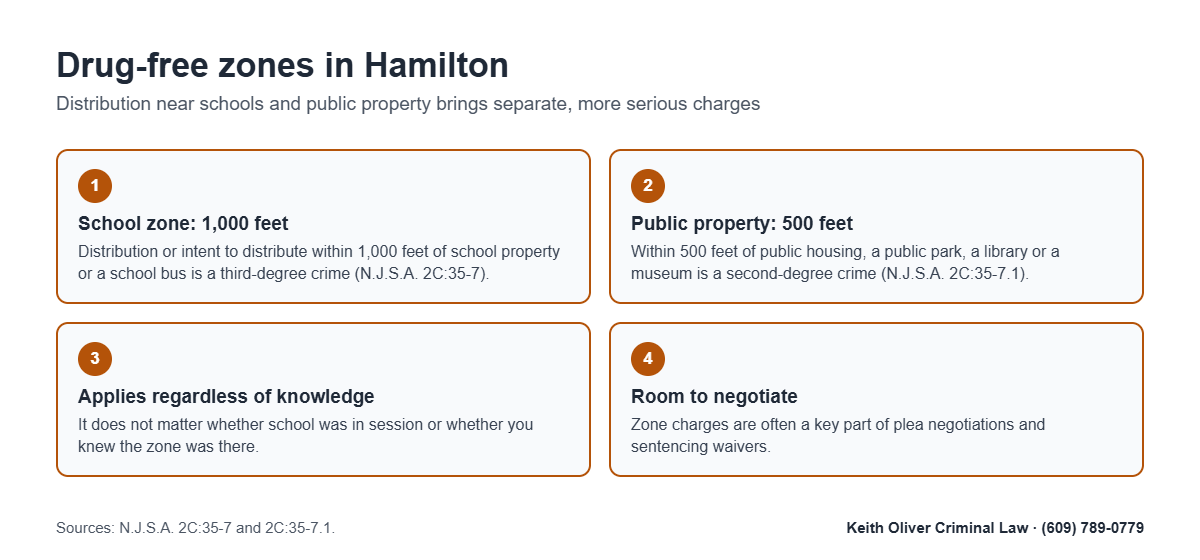
Drug-free school and public property zones add serious charges.
Highway Stops on I-195, I-295 and the Turnpike
Hamilton’s highways bring a steady flow of through traffic, and some drug cases begin with a stop for speeding, a lane violation or tinted windows. A routine stop can expand into a search if the officer claims to see something suspicious or asks for consent. New Jersey’s rules are strict: police need reasonable suspicion before asking to search a car, the smell of marijuana alone no longer justifies a search, and a warrantless vehicle search requires probable cause arising from unforeseeable circumstances. Stops on the Turnpike and some state highways are often made by the New Jersey State Police, which keeps its own video and records.
Searches of Homes and Apartments
When Hamilton police search a home, they generally need a warrant. Search warrants are based on sworn affidavits, often relying on confidential informants, controlled buys or surveillance. Those affidavits can be challenged if they contain false statements or lack enough detail to establish probable cause. The way the warrant was executed matters too, including whether police exceeded its scope. Drugs found in a shared residence also raise questions about who actually possessed them.
Where Hamilton Drug Cases Are Heard
Disorderly persons drug offenses, such as possession of non-cannabis drug paraphernalia, are heard in Hamilton Municipal Court at 1270 Whitehorse-Mercerville Road. Indictable drug charges go to the Mercer County Prosecutor’s Office, which may present them to a grand jury, divert them or downgrade them. Cases that proceed are handled in the Mercer County Superior Court in Trenton. If someone is held after an arrest, a first appearance follows quickly, and the State may seek pretrial detention in more serious distribution cases. Preparation for that hearing should start immediately.
Lab Testing and Weight
The State must prove both what the substance is and, in distribution cases, how much there was. We review the laboratory report, the testing methods, the scale calibration and the chain of custody. Small differences in weight can move a case across a grading threshold. Mixed substances, residue and packaging all raise questions. And because many seizures are now tested for fentanyl, the lab results can change the charge in either direction.
Diversion and Treatment Options
Many Hamilton drug cases end without a conviction. Pretrial Intervention is often available for first-time defendants charged with indictable possession and sometimes for lower-level distribution. Conditional discharge covers eligible disorderly persons drug offenses. Recovery Court offers an intensive, treatment-centered alternative for people whose charges are tied to addiction, including some who would otherwise face prison. Each program has its own requirements, and the timing of an application can matter.
Mandatory Penalties
Every drug conviction in New Jersey brings a mandatory Drug Enforcement and Demand Reduction penalty, from $500 for a disorderly persons offense up to $3,000 for a first-degree crime, along with a lab fee. Some distribution offenses carry periods of parole ineligibility. A conviction also affects employment, professional licensing, housing and immigration status. These consequences are part of why careful defense work early in the case is so valuable.
Defenses We Raise in Hamilton Drug Cases
- Unlawful stop or search. Suppression of evidence found through a constitutional violation.
- Defective search warrant. False or insufficient statements in the affidavit.
- No possession. Drugs in a shared car or home that belonged to someone else.
- No intent to distribute. Quantity, packaging and cash consistent with personal use.
- Lab and weight challenges. Errors in identification, weighing or chain of custody.
- Zone challenges. Measurements and maps that do not support a school or park zone charge.
Juveniles and Young Adults
If the person charged is under 18, the case is handled in the Family Part of Superior Court, where the focus is on rehabilitation. For young adults in Hamilton’s high schools and nearby colleges, a first drug charge is often a good candidate for diversion. Protecting the record early keeps college, financial aid and job opportunities open.
What to Do After a Hamilton Drug Arrest
Do not discuss the case on the phone, by text or on social media, and do not talk with anyone else who was charged. Follow all release conditions. Write down the details of the stop or search, including what the officers said and whether they asked for consent. Gather your paperwork and talk to a lawyer before your first court date or first appearance.
Hamilton Drug Charge FAQs
What makes a drug charge “intent to distribute”?
Police rely on quantity, packaging, scales, cash and messages. Those facts are circumstantial and can often be challenged.
How big is a school zone?
1,000 feet from school property or a school bus. Public property zones, such as parks and public housing, extend 500 feet.
Can a distribution charge be reduced to possession?
Yes, when the evidence of intent to sell is weak or the search is challenged successfully.
Is PTI available for drug charges?
Often, especially for first-time possession charges. Eligibility for distribution charges is more limited.
Where is my Hamilton drug case heard?
Disorderly persons charges stay in Hamilton Municipal Court. Indictable charges go to Superior Court in Trenton.
Drug and Marijuana Defense Across Mercer County
We defend drug and marijuana charges in every Mercer County town, including:
- Ewing drug possession
- Ewing prescription drug charges
- Hightstown drug charges
- Princeton drug possession
- Robbinsville drug crimes
- West Windsor drug possession
- Trenton heroin possession
- Ewing marijuana charges
- Hamilton marijuana charges
- Lawrence marijuana charges
For the statutes and county-level information, see our Mercer County drug charges page.
Talk to a Hamilton Drug Crime Lawyer
From a highway stop to a search warrant, the way a Hamilton drug case begins often determines how it can end. Keith Oliver Criminal Law defends drug charges in Hamilton and throughout Mercer County. Call Keith Oliver Criminal Law at (609) 789-0779 or contact us online.