
Drug possession arrests in Ewing Township happen in many settings: a traffic stop on Interstate 295 or Route 31, a call to an apartment complex off Parkway Avenue, a search after a minor accident on Olden Avenue, or an incident near The College of New Jersey. The charge may involve a few pills, a small bag of cocaine, a vial of fentanyl or drug paraphernalia found during a search for something else. Whatever the details, a drug charge can bring a criminal record, mandatory penalties and, in many cases, the possibility of state prison. If you were charged with drug possession in Ewing, the good news is that New Jersey offers several paths to avoid a conviction, and many cases have defenses rooted in how the evidence was found. This page explains how possession charges are graded, how they move through the courts, and the defenses and diversion programs available. To talk about your case, call Keith Oliver Criminal Law at (609) 789-0779.
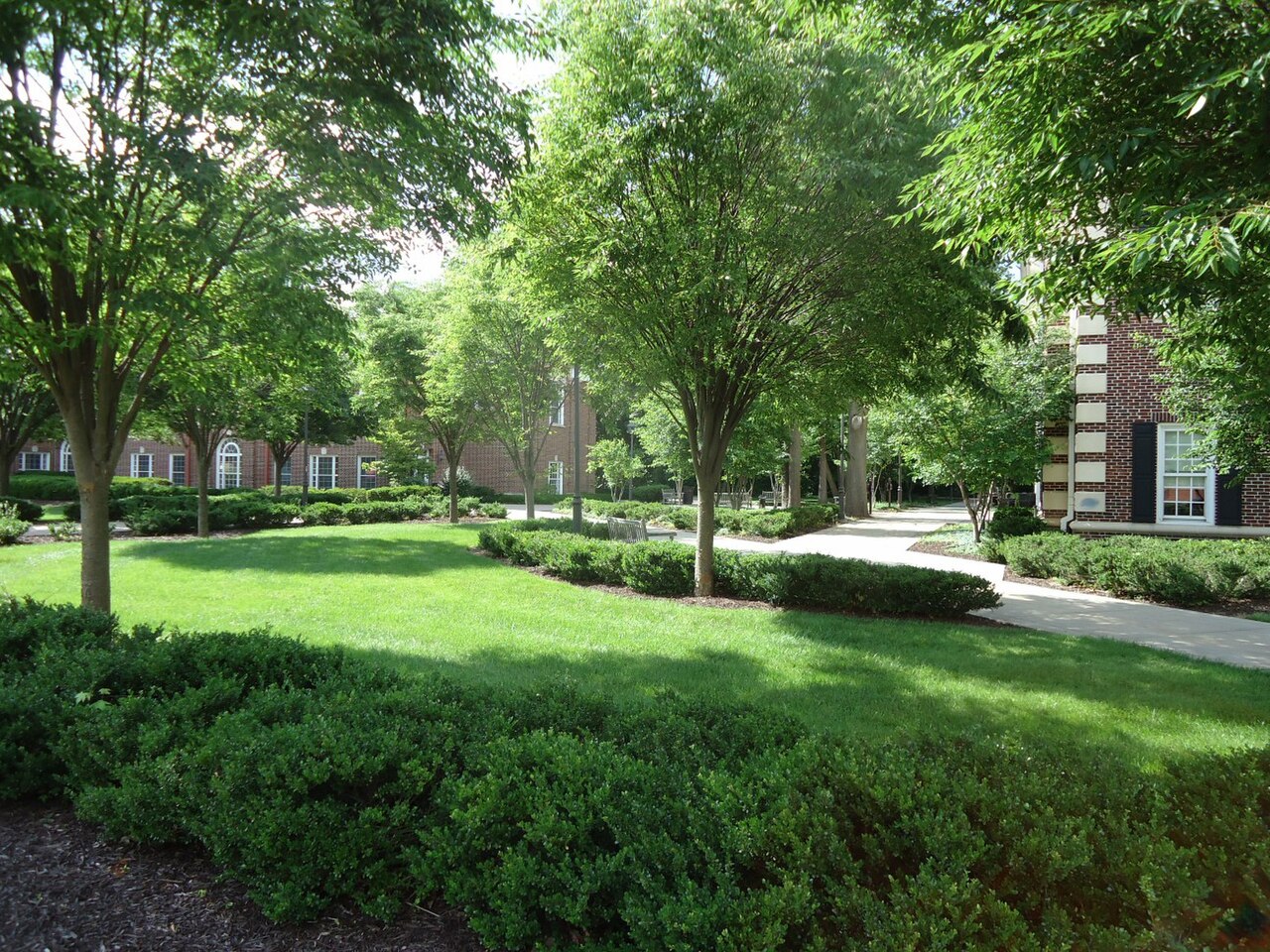
The College of New Jersey campus in Ewing Township. Photo: Tomwsulcer, Wikimedia Commons, CC0

How New Jersey Grades Drug Possession
Under N.J.S.A. 2C:35-10, simple possession of most controlled dangerous substances (CDS) is a third-degree crime. That includes heroin, cocaine, fentanyl, methamphetamine, MDMA and most prescription pills without a valid prescription. A third-degree crime carries three to five years in prison and a fine of up to $35,000. Possession of a Schedule V substance is a fourth-degree crime, as is possession of more than six ounces of marijuana or more than 17 grams of hashish. Possession of non-cannabis drug paraphernalia is a disorderly persons offense heard in Ewing Municipal Court. Because most possession charges are indictable, they are usually sent from Ewing to the Mercer County Prosecutor’s Office and, unless downgraded, to the Superior Court in Trenton. See our drug possession page for more on the statute.
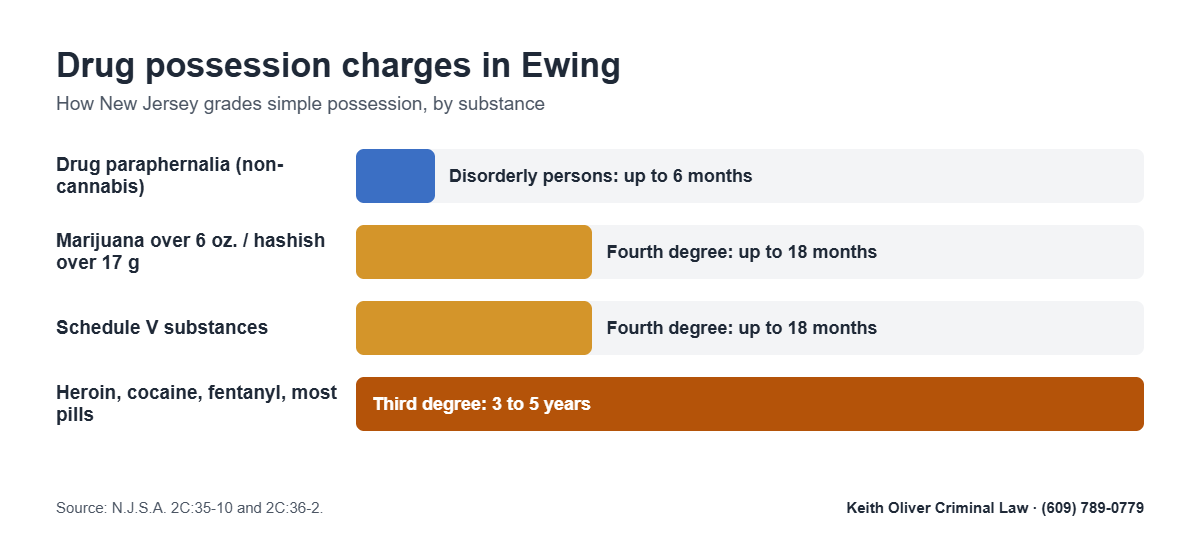
How simple possession is graded in New Jersey, by substance.
Where Ewing Drug Cases Start
Many Ewing drug charges begin with a motor vehicle stop. Interstate 295, Route 29 along the river, Route 31 (Pennington Road) and Scotch Road carry heavy traffic, and a stop for a minor violation can turn into a search. Other cases start with a call for service at a residence, a search incident to an arrest on a warrant, or a report from campus or apartment security. How the encounter began, and every step after it, matters to the defense.
Search and Seizure: Often the Strongest Defense
The New Jersey Constitution gives residents more protection against searches than federal law does. In a drug case, we look at each step:
- The stop. Police need reasonable suspicion of a motor vehicle violation or criminal activity.
- Consent. Under State v. Carty (2002), police need reasonable suspicion before even asking to search a car, and consent must be voluntary.
- Odor of cannabis. Since the 2021 cannabis laws, the smell of marijuana alone cannot justify a search.
- Automobile exception. Under State v. Witt (2015), a warrantless car search requires probable cause arising from unforeseeable and spontaneous circumstances.
- Home searches. Entering a home generally requires a warrant or a recognized exception such as genuine exigency.
If evidence was found through an unlawful stop or search, a motion to suppress can lead to its exclusion and often to dismissal.
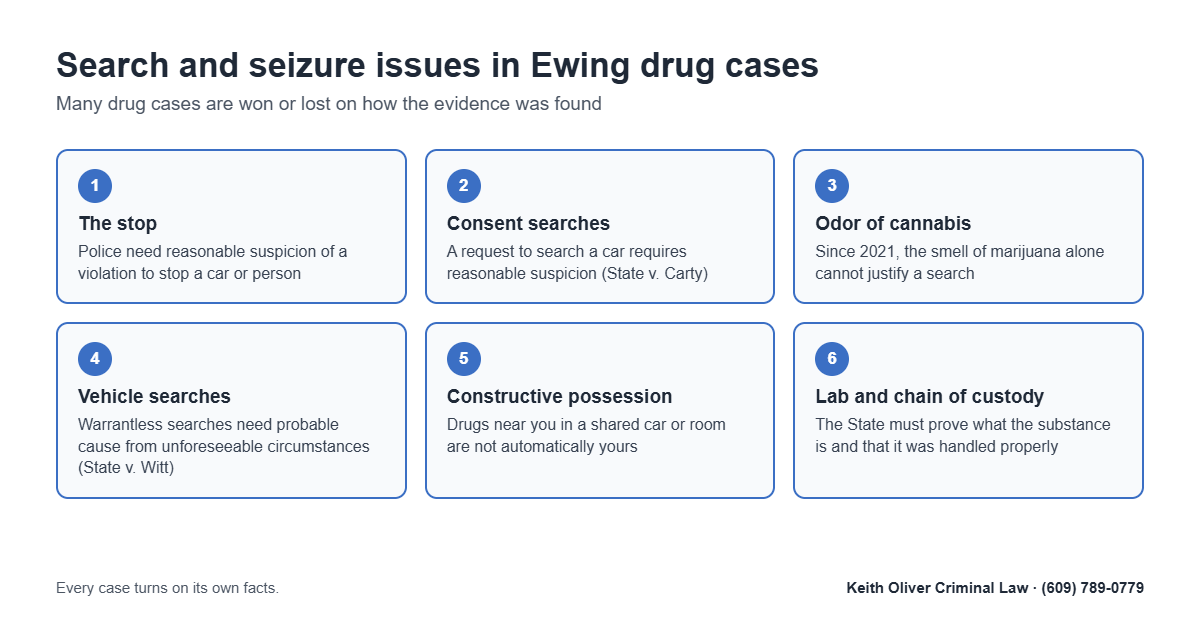
The search and seizure questions that decide many drug cases.
Constructive Possession and Shared Spaces
Possession does not always mean the drugs were in your pocket. The State can charge “constructive possession” when it claims a person knew about the drugs and had the intent and ability to control them. That theory is common when drugs are found in a shared car, an apartment with roommates or a dorm room. But proximity alone is not enough. Who owned the car, who had access to the room, where the item was found and whether anyone else had a stronger connection all bear on whether the State can prove you possessed it.
The Lab Report and Chain of Custody
The State must prove that the substance is what it claims to be. That usually requires a laboratory analysis, and in New Jersey the defense can demand that the analyst testify. We review the lab report, the testing methods and the chain of custody, from the moment the evidence was seized until it was tested. Gaps, mislabeling and delays can create reasonable doubt. Field tests done at the roadside are not a substitute for a proper lab analysis.
Diversion: Avoiding a Conviction
Many people charged with drug possession in Ewing can avoid a conviction entirely:
- Conditional discharge. For disorderly persons drug offenses such as paraphernalia, a one-time program that ends in dismissal after a period of supervision.
- Pretrial Intervention (PTI). For indictable possession, often available to first-time offenders, with dismissal after successful supervision.
- Recovery Court. A treatment-centered program in Superior Court for people whose charges are tied to a substance use disorder.
Each program has eligibility rules and conditions, and the timing of an application can matter.
Mandatory Penalties and Collateral Consequences
A drug conviction carries mandatory financial penalties, including the Drug Enforcement and Demand Reduction (DEDR) penalty, which ranges from $500 for a disorderly persons offense to $1,000 for a third-degree crime, plus a lab fee. A conviction can also affect employment, professional licenses, housing and, for non-citizens, immigration status. Drug offenses are among the most serious immigration triggers, so any non-citizen should get advice before entering a plea.
TCNJ Students and Young Adults
For college students, a drug charge can bring campus discipline on top of the court case, and statements to campus officials can be used in court. If you are a student, get legal advice before attending any university meeting. Young adults with no prior record are often good candidates for diversion, which can protect both their record and their future plans.
Overdose Situations and the Good Samaritan Law
New Jersey’s Overdose Prevention Act protects a person who seeks medical help for someone experiencing an overdose, and the person who overdosed, from being charged with simple possession and certain related offenses based on evidence found because help was called. The protection has limits, but it exists so that people call 911 without fear. If your charge arose from an overdose call, tell your lawyer right away.
What to Do After an Ewing Drug Arrest
Do not discuss the case with anyone except your lawyer, including friends who were present. Do not post about it. Write down the details of the stop or search while you remember them: where you were, what the officers said, whether they asked for consent and what you answered. Gather paperwork such as summonses, property receipts and any release conditions. Then talk to a lawyer before your first court date.
Possession With Intent to Distribute
Sometimes a possession arrest is charged as something more serious: possession with intent to distribute under N.J.S.A. 2C:35-5. Police may point to the quantity, packaging, scales, cash or text messages as evidence of intent to sell. Those charges are graded by drug and quantity and can carry far longer sentences, especially near schools or public property. But the evidence of intent is often circumstantial. Many people buy in quantity for personal use, carry cash for ordinary reasons or have a scale for legal purposes. Challenging the intent element can reduce a distribution charge to simple possession, which opens the door to diversion. If drugs were found in a vehicle, see also our page on possession of CDS in a motor vehicle.
Ewing Drug Possession FAQs
Is drug possession a felony in New Jersey?
New Jersey uses the term “indictable crime.” Possession of most drugs is a third-degree crime with three to five years of prison exposure.
Can I avoid a conviction for a first drug offense?
Often, yes. Pretrial Intervention and conditional discharge can lead to dismissal for eligible defendants.
Can police search my car because it smells like marijuana?
Not based on odor alone. New Jersey law no longer allows the smell of cannabis by itself to justify a search.
What if the drugs were not mine?
The State must prove you knowingly possessed them. Shared cars and rooms often raise constructive possession defenses.
Where will my Ewing drug case be heard?
Disorderly persons charges stay in Ewing Municipal Court. Indictable charges go to the Mercer County Prosecutor and Superior Court in Trenton.
Drug and Marijuana Defense Across Mercer County
We defend drug and marijuana charges in every Mercer County town, including:
- Ewing prescription drug charges
- Hamilton drug charges
- Hightstown drug charges
- Princeton drug possession
- Robbinsville drug crimes
- West Windsor drug possession
- Trenton heroin possession
- Ewing marijuana charges
- Hamilton marijuana charges
- Lawrence marijuana charges
For the statutes and county-level information, see our Mercer County drug charges page.
Talk to a Ewing Drug Possession Lawyer
The way the evidence was found, and the choices made in the first weeks, often decide a drug case. Keith Oliver Criminal Law defends drug charges in Ewing and throughout Mercer County. Call Keith Oliver Criminal Law at (609) 789-0779 or contact us online.