
If you have been served with a temporary restraining order (TRO) in Mercer County, you probably have one question: can I stop this from becoming permanent? The answer depends on the facts, the evidence and how well you prepare for the final restraining order (FRO) hearing, which is usually scheduled within about 10 days. A final restraining order in New Jersey has no expiration date, and it can affect where you live, your access to your children, your job and your right to own firearms. This page explains the realistic options for avoiding a final restraining order and what you can do right now.
The Mercer County domestic violence defense lawyers at Keith Oliver Criminal Law represent people in restraining order hearings at the Mercer County Family Part in Trenton. Our Mercer County office is at 100 Horizon Center Boulevard in Hamilton. Call (609) 789-0779 as soon as you are served.
How a Restraining Order Case Moves Forward
Restraining orders in New Jersey are governed by the Prevention of Domestic Violence Act, N.J.S.A. 2C:25-17 and following. The process moves quickly:
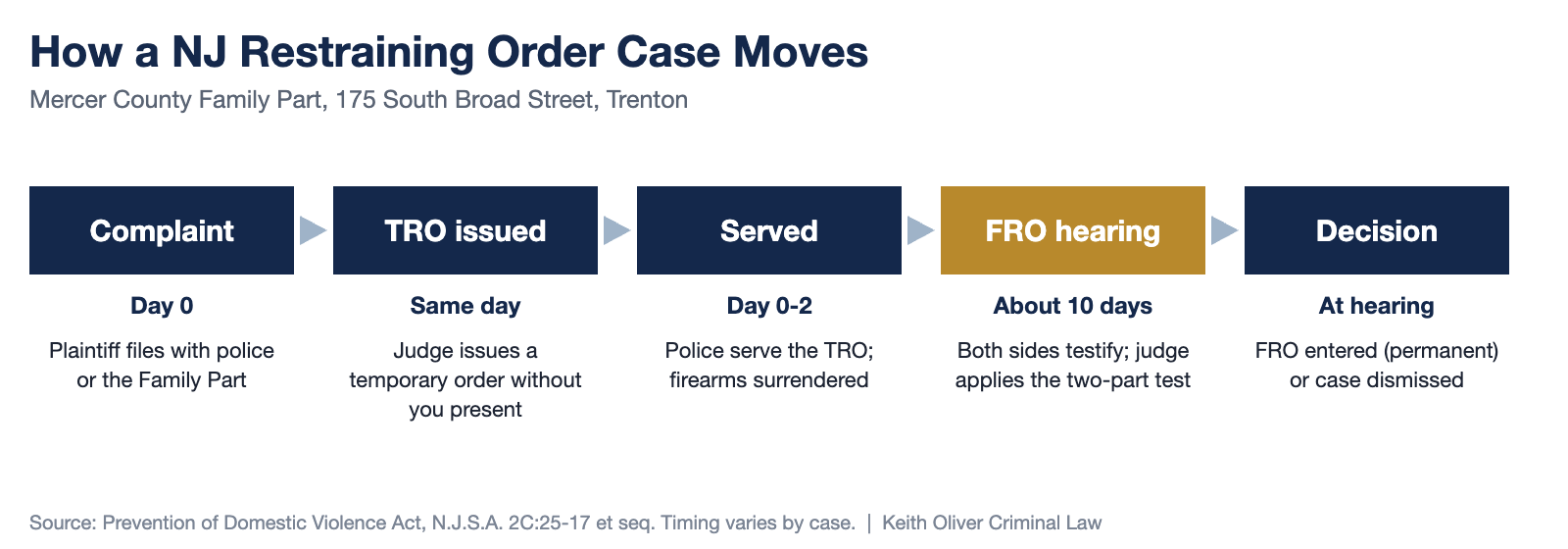
- The complaint and TRO. The other person, called the plaintiff, files a complaint with the police or the Family Part. A judge can issue a temporary restraining order the same day, based only on the plaintiff’s account. You are not present and have no chance to respond at that stage.
- Service. Police serve you with the TRO. It may order you out of your home, bar contact with the plaintiff, and require you to surrender firearms.
- The FRO hearing. A hearing is generally scheduled within about 10 days at the Family Part. In Mercer County, Family Part matters are heard at the Mercer County Civil Courthouse, 175 South Broad Street in Trenton.
- The decision. At the hearing, a judge hears testimony from both sides and decides whether to enter a final restraining order or dismiss the case.
Our Mercer County Courthouse guide explains parking, security and how to find the right building in downtown Trenton.
What the Plaintiff Must Prove
To get a final restraining order, the plaintiff must prove by a preponderance of the evidence (more likely than not) two things, under the test the courts adopted in Silver v. Silver:
- A predicate act. That you committed one of the offenses listed in the statute, such as harassment, assault, terroristic threats, criminal mischief, stalking, cyber-harassment or trespass.
- A need for protection. That a restraining order is necessary to protect the plaintiff from immediate danger or further abuse. The judge considers the history between the parties and the circumstances of the incident.
The parties must also have a qualifying relationship: spouses or former spouses, current or former household members, people who have a child together or expect one, or people in a current or former dating relationship.
Realistic Ways to Avoid a Final Restraining Order
1. Win the hearing
Many FROs are denied because the plaintiff cannot prove both prongs. Common defenses include showing that the incident did not happen as described, that the conduct does not meet the legal definition of a predicate act (for example, a single heated argument may not be harassment), that there is no history or ongoing need for protection, or that the plaintiff has a motive to exaggerate, such as a pending divorce or custody dispute. Preparation matters: texts, call logs, social media messages, video, witnesses and police body camera footage can all change the outcome. Cross-examination of the plaintiff is often decisive.
2. The plaintiff asks to dismiss
The plaintiff can choose to dismiss the TRO. To do so, the plaintiff generally must appear before the court, and the judge will ask whether the decision is voluntary. You must not contact the plaintiff to ask for a dismissal. Doing so violates the TRO and can lead to a criminal contempt charge.
3. Civil restraints instead of an FRO
In some cases, both sides agree to resolve the matter with “civil restraints,” a consent order in the Family Part in which each party agrees to limit contact. Civil restraints are not a finding of domestic violence, are not entered in the domestic violence registry, and do not carry the automatic firearms consequences of an FRO. They are not available in every case and require agreement from the plaintiff and approval by the court.
4. Request a short adjournment to prepare
Due process gives a defendant a fair opportunity to prepare, including time to retain counsel and gather evidence. If you have just been served and the hearing is days away, a lawyer can request a reasonable adjournment. The TRO stays in effect during any adjournment.
Consequences of a Final Restraining Order
- It is permanent. An FRO stays in place unless a judge later dissolves it. Getting it vacated is difficult and requires showing changed circumstances.
- Firearms. You must surrender firearms and are barred from obtaining a firearms ID card or permit while the order is in effect.
- Registry and fingerprinting. You will be fingerprinted and entered into the statewide domestic violence registry, which can be seen in certain background checks, including for jobs working with children.
- Home and children. The order can bar you from your home and affect custody and parenting time.
- Penalties. The court imposes a civil penalty and may order counseling or other relief.
- Contempt. Any violation, even a single text message, can be charged as contempt, a criminal offense. See our page on violating a restraining order.
The Criminal Case Is Separate
A domestic violence incident often produces two cases: the restraining order case in the Family Part and a criminal charge, such as simple assault or domestic violence assault, in municipal or Superior Court. What you say at the FRO hearing can be used in the criminal case, so the two must be handled together. Do not testify at the FRO hearing without first talking to a lawyer about the criminal exposure.
What to Do Right Now If You Were Served With a TRO
- Follow every term of the TRO exactly. Do not contact the plaintiff directly or through friends, family or social media.
- Write down your account of what happened while it is fresh.
- Save texts, emails, call logs, photos and social media messages. Do not delete anything.
- Make a list of witnesses who saw the incident or the relationship.
- Arrange to retrieve personal belongings only through the police, as the TRO allows.
- Call a lawyer immediately. The hearing is usually days away.
Common Predicate Acts in Mercer County Cases
Most restraining order cases involve one of a handful of predicate acts:
- Harassment. Communications or conduct made with the purpose to harass, such as repeated texts or calls, offensive language meant to alarm, or unwanted touching. Ordinary arguments, rude comments or communications with a legitimate purpose, such as discussing children, are not harassment.
- Assault. Causing or attempting to cause bodily injury, or putting someone in fear of imminent serious bodily injury.
- Terroristic threats. Threatening violence with the purpose to terrorize, or threatening to kill under circumstances that make the threat believable.
- Criminal mischief. Damaging property, such as a phone, a car or household items, during an argument.
- Stalking and cyber-harassment. A course of conduct that would cause a reasonable person to fear for their safety, or harassing communications online or through social media.
Cross-Complaints and Mutual Allegations
Sometimes both people file complaints after the same incident. Each complaint is decided on its own facts, and a judge can enter an FRO against one party, both parties or neither. If you were also a victim, a lawyer can help you decide whether to file your own complaint and how to present your case without hurting your defense.
Preparing to Testify at the Hearing
FRO hearings are trials. Both sides testify under oath, present evidence and call witnesses, and the judge evaluates credibility. Preparation includes organizing a clear timeline, gathering and printing relevant messages, identifying witnesses and practicing how to answer questions calmly and directly. Your lawyer will also prepare you for cross-examination by the plaintiff’s attorney and decide whether testifying is in your best interest given any related criminal charge.
Effects on Jobs, Immigration and Custody
A final restraining order can affect employment in fields that require background checks, such as education, health care, law enforcement and jobs involving children. It can also be considered in immigration matters and in custody and parenting time decisions in a related family case. These collateral consequences are another reason to take the hearing seriously from the start.
Frequently Asked Questions
Can I avoid a final restraining order in New Jersey?
Yes, in many cases. The plaintiff must prove both a predicate act and a need for protection. If the evidence falls short, the judge must dismiss the TRO. Other options include a voluntary dismissal by the plaintiff or an agreement to civil restraints.
How long does a restraining order last in New Jersey?
A final restraining order has no expiration date. It stays in effect until a judge dissolves it.
Can the plaintiff drop the restraining order?
The plaintiff can ask the court to dismiss it, usually by appearing before a judge. You must not contact the plaintiff to request this, because that would violate the TRO.
Do I need a lawyer for a restraining order hearing?
There is no public defender for restraining order hearings, and the consequences are permanent. An attorney can cross-examine the plaintiff, present evidence and protect you from statements that could hurt you in a related criminal case.
Where are Mercer County restraining order hearings held?
Final restraining order hearings are held in the Family Part of the Superior Court at the Mercer County Civil Courthouse, 175 South Broad Street in Trenton.
Talk to a Mercer County Restraining Order Lawyer
Keith Oliver Criminal Law is part of Proetta & Oliver, LLC. We prepare clients for FRO hearings in Trenton and defend related criminal charges across Mercer County, including Lawrence restraining orders and Princeton domestic violence charges. Call (609) 789-0779 or contact us online as soon as you are served. Learn more about our Mercer County domestic violence defense.