

Assault charges in Ewing Township come from many places: a disagreement between neighbors that turns physical, a fight outside a bar or restaurant on Olden Avenue or Parkway Avenue, a confrontation at a youth sporting event, a dispute in a parking lot or an argument at a party near The College of New Jersey. Some cases begin with a 911 call and an arrest by the Ewing Police. Others begin when one person walks into the municipal building and signs a complaint against another.
However it started, an assault charge deserves serious attention. Even a simple assault can mean jail, a criminal record and, if it involves a family or household member, a restraining order. If you were charged in Ewing, call Keith Oliver Criminal Law at (609) 789-0779 to talk about your case.
Ewing Township Municipal Building, home of the municipal court and police. Photo: Famartin, Wikimedia Commons, CC BY-SA 3.0

Simple Assault or Aggravated Assault?
New Jersey’s assault statute, N.J.S.A. 2C:12-1, divides assault into two broad categories. Simple assault covers attempting to cause or causing bodily injury, negligently causing bodily injury with a deadly weapon, or using physical menace to put someone in fear of serious injury. It is a disorderly persons offense, heard in Ewing Municipal Court, with up to six months in jail. If the fight was entered into by mutual consent, it is a petty disorderly persons offense with up to 30 days.
Aggravated assault is an indictable crime handled in Superior Court in Trenton. It applies when there is serious or significant bodily injury, when a deadly weapon is involved, or when the victim belongs to a protected group such as police officers, firefighters, EMTs, school employees and health care workers. Depending on the facts, it can be a second-, third- or fourth-degree crime.
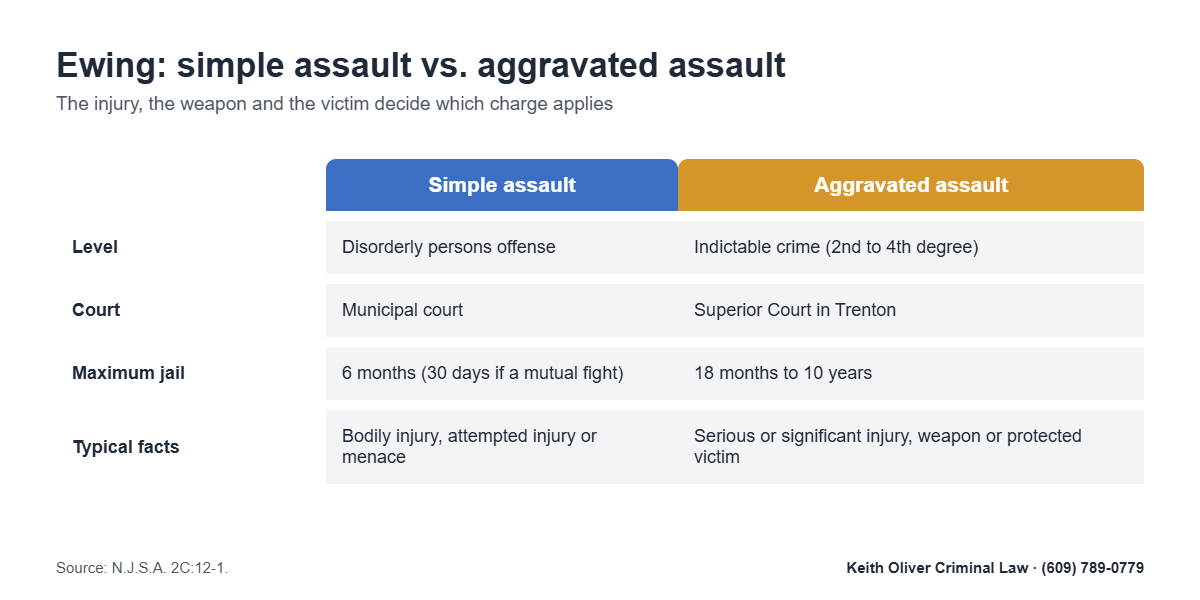
The key differences between simple and aggravated assault.
How Assault Cases Start in Ewing
There are two main ways an assault case begins. In a police-initiated case, Ewing officers respond to a call, interview the people involved and decide whether to file charges. In a citizen complaint, a private person goes to the court and signs a complaint, and a judicial officer decides whether there is probable cause to issue a summons. Ewing’s court accepts complaints during the Violations Bureau hours on weekdays.
Citizen complaints have their own dynamics. The person who files first is not necessarily the victim, and it is common for both sides to file complaints against each other. Cross-complaints can affect how the prosecutor views the case and open the door to a mutual resolution.
Ewing Municipal Court and Mediation
Simple assault cases are heard at Ewing Township Municipal Court, 2 Jake Garzio Drive. Many regular sessions are held on Zoom, but trials and contested hearings take place in person. The court’s number is (609) 883-2900.
Ewing’s court also lists mediation among its services. For some disputes between neighbors, acquaintances or co-workers, the court can refer the matter to trained mediators who help the parties reach an agreement without a trial. Mediation is not available in every case, and it is generally not used for domestic violence matters, but in the right situation it can end a case without a conviction. See our Ewing Municipal Court page for more about the court.
TCNJ Students and Campus Incidents
With The College of New Jersey in town, some Ewing assault cases involve students. An incident on campus may be handled by the college’s own police department, while an off-campus party or bar fight is usually handled by Ewing police. Either way, a student can face two processes at once: the criminal case and a campus conduct proceeding. Statements made in one can affect the other. A student should get legal advice before meeting with college officials about the incident, and should be careful about texts and social media posts, which are often used as evidence.
Self-Defense and Defense of Others
New Jersey law allows a person to use force when they reasonably believe it is immediately necessary to protect themselves against unlawful force. The force must be proportional to the threat, and a person who started the confrontation with intent to cause harm generally cannot claim self-defense. The law also permits reasonable force to protect another person. Once the defense is raised with some supporting evidence, the State must disprove it beyond a reasonable doubt.
Self-defense cases turn on details: who moved first, what was said, whether anyone had a weapon, and what witnesses and cameras captured. We gather that evidence early, before memories fade and video is overwritten.
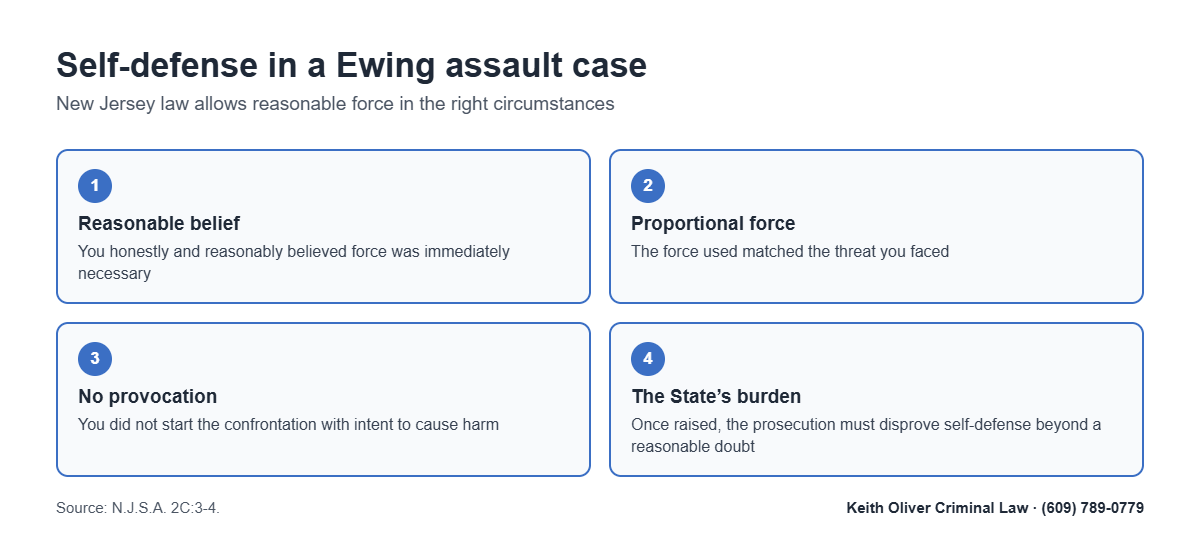
The elements of self-defense under New Jersey law.
Penalties and Collateral Consequences
A simple assault conviction can bring up to six months in jail, a fine of up to $1,000 and probation. Aggravated assault carries prison exposure ranging from 18 months for a fourth-degree offense to 10 years for a second-degree offense, and many second-degree aggravated assaults fall under the No Early Release Act, which requires serving 85 percent of the sentence before parole. Any assault conviction creates a criminal record. If the people involved are family or household members, the case is a domestic violence assault, and a restraining order may follow.
Defending an Ewing Assault Charge
Beyond self-defense, assault cases are often defended on the facts:
- No injury, or a lesser injury. The grade depends on the injury. Medical records can show that an injury was minor or did not exist.
- Credibility. Many assault cases come down to one person’s word against another’s. Inconsistent statements and motives to fabricate matter.
- Video. Phone videos, doorbell cameras and business surveillance often show a different sequence of events.
- Mutual combat. A fight entered into by mutual consent is a petty disorderly persons offense, not a disorderly persons offense.
- Identification. In a crowded fight, the wrong person can be charged.
Resolving the Case Without a Conviction
Many simple assault cases can be resolved without a conviction. Depending on the facts and your record, options may include a conditional dismissal for a first-time offense that does not involve domestic violence, mediation, an agreement to dismiss cross-complaints, or a plea to a lesser offense such as a local ordinance violation. Aggravated assault charges may be eligible for Pretrial Intervention or a downgrade to municipal court. After a dismissal, the arrest can usually be expunged.
What to Do Now
Do not contact the other person to talk about the case, even to apologize. Messages can be used as admissions, and contact may violate bail conditions or a restraining order. Save any evidence that helps you, including photos of your own injuries, texts and the names of witnesses. Write down what happened while you remember it clearly. Then talk to a lawyer before your first court date.
When a Police Officer Is Involved
Some Ewing assault cases arise during an arrest for something else entirely. A person who pulls away, struggles or flails while being handcuffed can be charged with resisting arrest and, if an officer claims to have been struck or injured, with aggravated assault on a police officer. Because officers are protected victims, even a simple assault on an officer is charged as aggravated assault: a fourth-degree crime without bodily injury, and a third-degree crime with it.
These cases deserve careful scrutiny. Body camera footage often shows a more chaotic and ambiguous struggle than the report describes, and an accidental contact during an arrest is not the same as a purposeful assault. We obtain every available camera angle and compare it with the officers’ reports, use-of-force forms and any medical records.
Bail Conditions and No-Contact Orders
If you were arrested on a warrant or charged with an indictable assault, the court may set release conditions, such as no contact with the alleged victim. Violating those conditions can lead to detention. Read your release paperwork carefully and ask your lawyer if anything is unclear.
Ewing Assault FAQs
What is the difference between simple and aggravated assault?
Simple assault is a disorderly persons offense in municipal court. Aggravated assault is an indictable crime involving serious injury, a weapon or a protected victim.
Can someone file an assault charge against me without the police?
Yes. A private citizen can file a complaint at the municipal court, and a judicial officer decides whether to issue a summons.
Can I file a complaint against the other person too?
Yes, if you have a good-faith basis. Cross-complaints are common in Ewing assault cases.
Is mediation available?
For some disputes, Ewing’s court can refer cases to mediation. It is generally not used in domestic violence cases.
Can an assault charge be expunged?
A dismissed charge can usually be expunged right away. A conviction requires a waiting period.
Assault Defense in Other Mercer County Towns
We defend assault charges across Mercer County, including:
- Hamilton aggravated assault defense
- Hamilton simple assault defense
- Lawrenceville assault defense
- West Windsor simple assault defense
For more on the law, see our pages on assault and threat crimes, assault on a police officer and terroristic threats.
Talk to a Ewing Assault Defense Lawyer
An assault charge in Ewing can often be resolved far better than people expect, but the early decisions matter. Keith Oliver Criminal Law defends assault charges in Ewing and throughout Mercer County. Call Keith Oliver Criminal Law at (609) 789-0779 or contact us online.