
If you or someone close to you has been charged with an indictable crime anywhere in Mercer County, the case will be decided at the Mercer County Criminal Courthouse on South Warren Street in Trenton. That building is where first appearances, detention hearings, plea negotiations, motions and jury trials take place for every felony-level charge filed from Hopewell to Hightstown.
Mercer County is a busy, fast-moving court. Police here are more likely than almost anywhere else in central New Jersey to take an arrested person to jail on a complaint-warrant instead of releasing them with a court date, so the first few days of a Mercer County case often decide whether the person goes home. This guide explains how the court works, the deadlines that apply when someone is held, and the points where a case can be resolved early. Our attorneys at Keith Oliver Criminal Law appear in this courthouse regularly from our Hamilton office, just a short drive away.
Mercer County Superior Court at a Glance
| Courthouse | Mercer County Criminal Courthouse, 400 South Warren Street, Trenton, NJ 08650 |
| Prosecutor | Mercer County Prosecutor’s Office, County Courthouse, 209 South Broad Street, Trenton, NJ 08650 |
| County jail | Mercer County Correction Center, 1750 River Road (Route 29), Hopewell Township, NJ |
| Vicinage | Mercer Vicinage (Vicinage 7), which covers Mercer County only |
| Cases heard | Indictable (first- through fourth-degree) crimes committed anywhere in Mercer County’s 12 municipalities |
| Our nearest office | 100 Horizon Center Boulevard, Hamilton, NJ 08691 · (609) 789-0779 |
The Clock That Starts When Someone Is Held in Mercer County
Since New Jersey’s Criminal Justice Reform Act took effect in 2017, cash bail has largely disappeared. In its place is a system of release decisions, pretrial monitoring and strict deadlines. Those deadlines matter most for people who are held in jail, and in Mercer County more people are held at the start than in most counties. The chart below shows the main steps and the points where a detained defendant can be released.
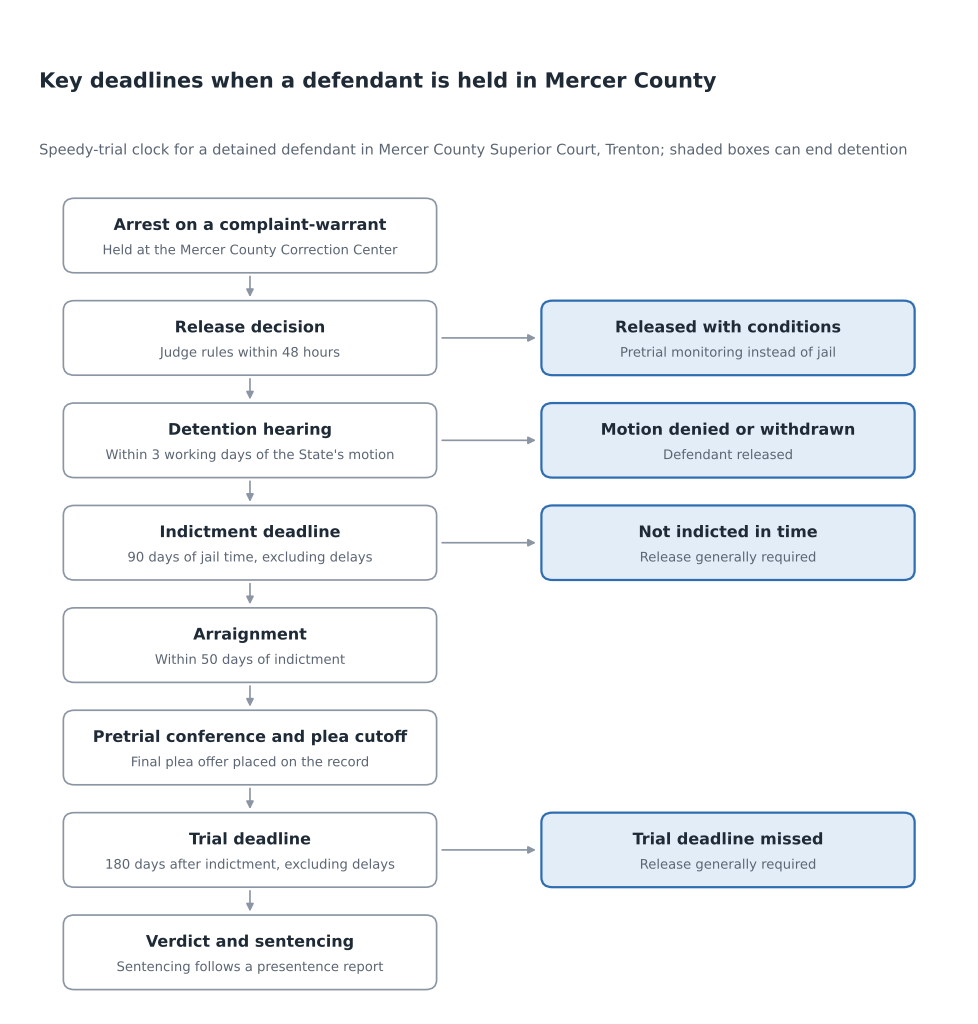
Deadlines under N.J.S.A. 2A:162-22 and the New Jersey Court Rules. Excludable time, such as delays requested by the defense, does not count toward the 90-day and 180-day limits.
These deadlines are not just technicalities. They give a defendant leverage. When the State is not ready to indict or try a case within the time the law allows, release is generally required. Tracking excludable time, objecting to unnecessary delay and holding the State to its obligations is part of defending a detained client in Trenton.
First Appearance and Detention Hearings in Trenton
Warrant or summons
Every Mercer County case begins with a complaint. If police issue a complaint-summons, the person is released and given a court date. If police issue a complaint-warrant, the person is taken to the Mercer County Correction Center in Hopewell Township. In 2024, Mercer County issued warrants to 2,646 of the 4,247 people charged, the highest rate of the three counties we serve and far above the statewide figure.
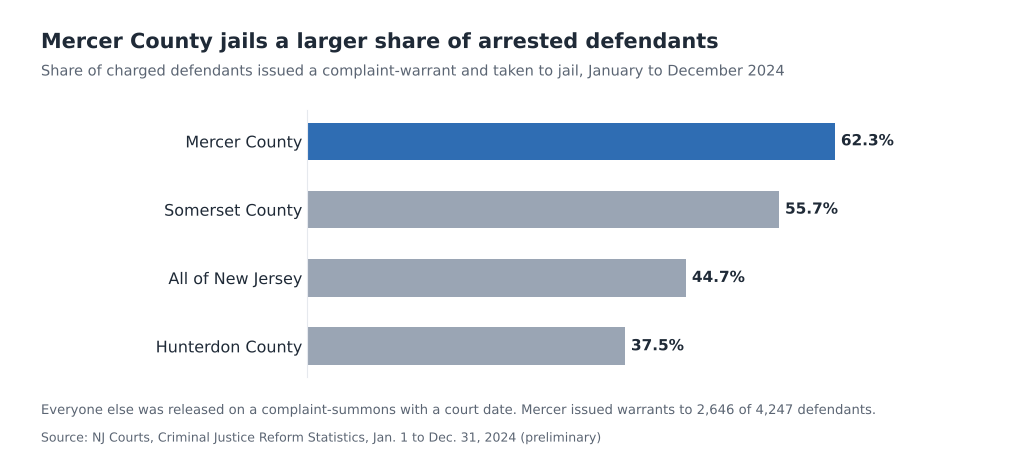
Source: NJ Courts, Criminal Justice Reform Statistics, Jan. 1 to Dec. 31, 2024 (preliminary).
Release decision within 48 hours
Once someone is held on a warrant, Pretrial Services prepares a Public Safety Assessment that scores the risk of failing to appear and of new criminal activity. A judge at Central Judicial Processing then decides whether to release the person and on what conditions, which can range from simple reporting to home detention with electronic monitoring. That decision must be made within 48 hours of commitment.
When the prosecutor moves to detain
The Mercer County Prosecutor’s Office can file a motion asking the court to hold a defendant until trial. The hearing is normally held within three working days. At the hearing, the State must show probable cause and convince the judge by clear and convincing evidence that no combination of conditions will protect the public, ensure court appearances and prevent obstruction. The defense can cross-examine witnesses, present information about the defendant’s ties to the community, and propose a release plan.
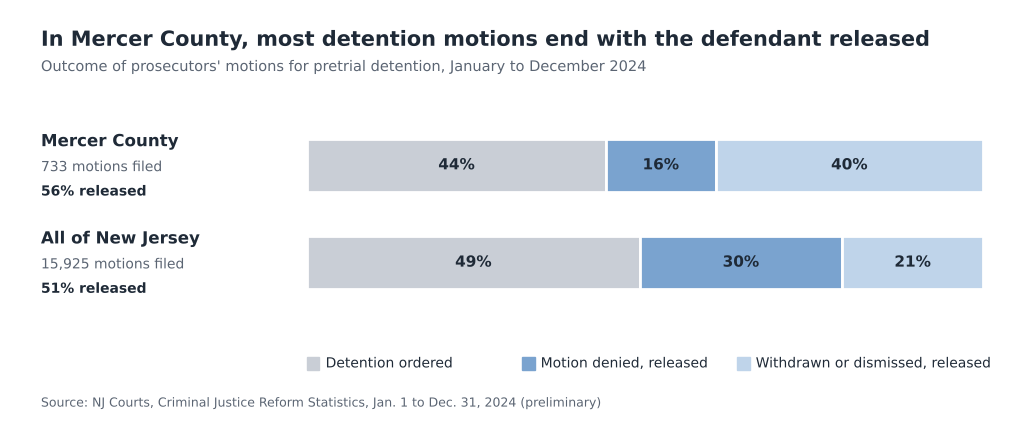
Released includes motions denied by a judge and motions withdrawn or dismissed. Source: NJ Courts, Criminal Justice Reform Statistics, Jan. 1 to Dec. 31, 2024 (preliminary).
The 2024 numbers show two things about Mercer County. Prosecutors here withdrew or dropped about 40 percent of their detention motions, roughly double the statewide share, which often happens after the defense presents a credible release plan. But when a Mercer County judge did decide a motion, the State won about 73 percent of the time. Preparation before the hearing, not argument alone, is what moves the needle.
Pretrial Intervention and Recovery Court in Mercer County
For many first-time defendants, the best outcome is never being convicted at all. Pretrial Intervention (PTI) allows eligible people charged with indictable offenses to complete a period of supervision, usually with conditions such as community service, counseling or restitution. If the program is completed, the charges are dismissed. Applications are generally due within 28 days after indictment, and admission requires a recommendation from the PTI program and the consent of the Mercer County Prosecutor’s Office. There are presumptions against admission for certain charges, including many first- and second-degree crimes, so a strong written application that explains why the case is different can be decisive.
For people whose charges are connected to drug or alcohol use, Recovery Court (formerly Drug Court) is another option. It combines intensive treatment and frequent court appearances with a sentence of special probation, and for some defendants it is an alternative to state prison. Mercer County participants appear before a Recovery Court judge in Trenton.
Before Indictment: Downgrades, Early Offers and the Grand Jury
After the first appearance, the case goes to the Mercer County Prosecutor’s Office for review. This is often the most important stage of the case, and many defendants do not realize it is happening. During this window, the defense can:
- Ask the prosecutor to downgrade the charge to a disorderly persons offense and send it to municipal court
- Present mitigating information, such as employment, treatment records or character letters
- Point out legal problems, such as an unlawful stop or search, before the State commits to an indictment
- Negotiate an early plea offer, which is often the most favorable offer the State will make
If the case is not resolved, the prosecutor presents it to a Mercer County grand jury. Grand juries have 23 members, and at least 12 must vote to indict. The defendant is not present, and the defense does not cross-examine witnesses. In limited situations, the defense can ask the prosecutor to present clearly exculpatory evidence. If the grand jury votes no bill, the charge is dismissed.
Because Mercer County files so many felony-level complaints, about 9,800 in the municipal courts between July 2024 and June 2025, the prosecutor’s office makes thousands of screening decisions each year. A defense lawyer who engages early gives your case the best chance of being treated as one that deserves a downgrade, diversion or dismissal.
After Indictment: Arraignment, Discovery and the Plea Cutoff
An indicted defendant is arraigned within 50 days of the indictment. At or before arraignment, the State must provide discovery: police reports, body-worn camera and dashcam video, lab results, witness statements and any recorded statements of the defendant. This is when a defense lawyer can evaluate the case in detail and file motions, including:
- Motions to suppress evidence obtained through an unlawful stop, search or warrant
- Motions to suppress statements taken in violation of Miranda
- Motions to dismiss a defective indictment
- Challenges to out-of-court identifications
Eventually the court holds a pretrial conference. The prosecutor’s final plea offer is placed on the record, and the defendant must decide whether to accept it. Under the New Jersey Court Rules, plea negotiations generally end after the pretrial conference, and a later guilty plea is usually to the charges in the indictment. Understanding the strength of the evidence before that date is critical.
Trial and Sentencing in Trenton
A Mercer County criminal trial is heard by a jury drawn from residents across the county. The State must prove each element of each charge beyond a reasonable doubt. The defendant does not have to testify or present evidence, and the jury cannot hold silence against them.
If there is a conviction or a guilty plea, the judge orders a presentence report and weighs statutory aggravating and mitigating factors at sentencing. New Jersey grades crimes by degree:
| Degree | Prison range | Maximum fine |
|---|---|---|
| First degree | 10 to 20 years | $200,000 |
| Second degree | 5 to 10 years | $150,000 |
| Third degree | 3 to 5 years | $15,000 |
| Fourth degree | Up to 18 months | $10,000 |
First- and second-degree crimes carry a presumption of imprisonment, while first-time offenders convicted of third- or fourth-degree crimes generally have a presumption against prison. Some offenses carry mandatory minimums, including Graves Act firearm offenses and violent crimes covered by the No Early Release Act, which requires serving 85 percent of the sentence before parole. Learn more about first-degree, second-degree, third-degree and fourth-degree charges, and about Mercer County sentencing procedures.
Mercer County Superior Court by the Numbers
The latest public court data paints a clear picture of how this court operates:
- 4,247 people were charged in Mercer County in 2024 and tracked under Criminal Justice Reform, and 62.3 percent were issued complaint-warrants.
- 733 detention motions were filed in 2024. About 56 percent ended with the defendant released.
- The Mercer County Criminal Division resolved 104.8 cases for every 100 new filings between July 2024 and June 2025, better than the statewide figure of 99.4, according to the Judiciary’s Court Management Statistics.
- Its backlog was 277 cases per 100 monthly filings, compared with 294 statewide.
In practice, that means cases in Trenton keep moving. Deadlines for PTI applications, motions and plea decisions arrive quickly, and defendants who wait to hire a lawyer can lose options they did not know they had.
Charges We Defend in Mercer County Superior Court
Our attorneys handle the full range of indictable charges heard in Trenton, including drug distribution and possession with intent, unlawful possession of a weapon and Graves Act charges, aggravated assault, theft, robbery and fraud, sex offenses and domestic violence charges. Juvenile matters are heard in the Family Division; see our Mercer County juvenile defense page. If your case is already over, our Mercer County expungement lawyers can help you clear the record.
We also defend clients in neighboring courts, including the Monmouth County Superior Court in Freehold. Read about our attorneys, including Keith G. Oliver and William A. Proetta, and review our case results.
Frequently Asked Questions
Where is the Mercer County criminal court? Indictable criminal cases are heard at the Mercer County Criminal Courthouse, 400 South Warren Street, Trenton, NJ 08650. Disorderly persons offenses, DWI and traffic tickets stay in the municipal court of the town where the offense happened, such as Trenton, Hamilton or Princeton.
Why was my family member taken to jail instead of being given a court date? Police in Mercer County issued complaint-warrants to about 62 percent of charged defendants in 2024, well above the statewide rate of about 45 percent. A warrant means the person is held at the Mercer County Correction Center until a judge makes a release decision, which must happen within 48 hours.
What happens if the prosecutor files a motion to detain? The defendant stays in jail until a detention hearing, which is normally held within three working days unless one side asks for more time. In 2024, more than half of Mercer County detention motions ended with the defendant released, either because a judge denied the motion or because the prosecutor withdrew it.
How long can the State keep someone in jail before indictment? Under New Jersey’s speedy-trial rules, a detained defendant generally must be indicted within 90 days of being jailed, not counting delays the law excludes. If the deadline passes, release is generally required, although the court can impose conditions.
Can I still apply for Pretrial Intervention if I have been indicted? Yes. PTI applications are generally due no later than 28 days after indictment. Admission requires a recommendation from the PTI program and consent from the Mercer County Prosecutor’s Office, so a complete application matters.
Will my case be sent back to municipal court? Some indictable charges are downgraded by the Mercer County Prosecutor’s Office and remanded to the municipal court as disorderly persons offenses. When that happens, the maximum jail exposure drops to six months and there is no grand jury or Superior Court trial.
Can I talk to a lawyer before my first appearance? Yes, and it helps. A lawyer can gather information about your job, family and community ties before the release decision and can be ready to argue at a detention hearing if the State files a motion.
Talk to a Mercer County Criminal Defense Lawyer
A case in Mercer County Superior Court can move quickly, and the earliest decisions, from release conditions to whether the prosecutor downgrades the charge, are often the most important. Keith Oliver Criminal Law offers free, confidential consultations 24 hours a day. Call our Hamilton office at (609) 789-0779 or contact us online to talk about your case.